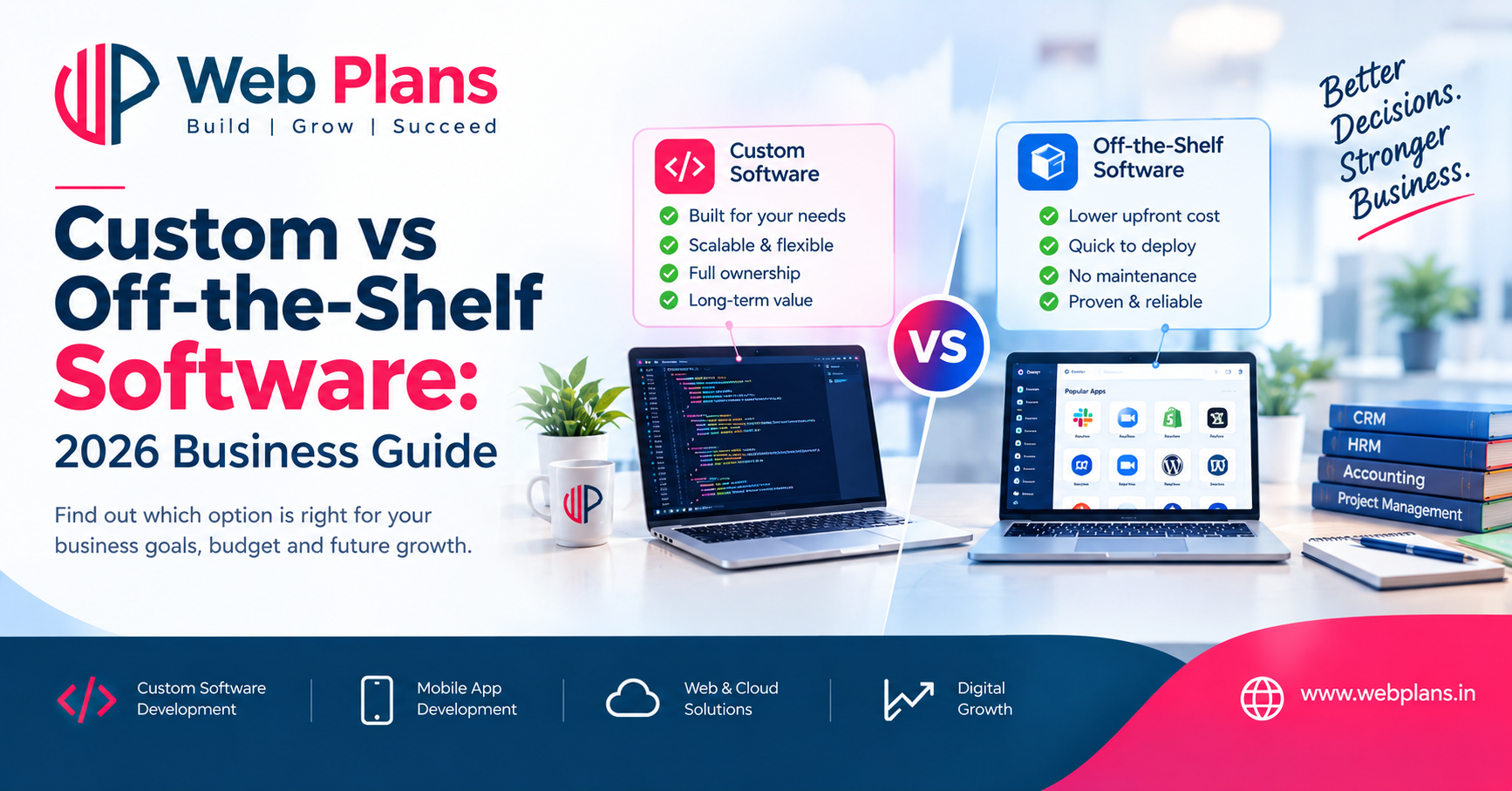
# Custom vs Off-the-Shelf Software: 2026 Business Guide
As digital transformation accelerates, choosing the right technological foundation is more critical than ever. For modern enterprises, startups, and growing businesses, one foundational debate continues to surface: **custom vs off-the-shelf software**.
Whether you are streamlining internal operations, launching a new customer-facing platform, or scaling your digital infrastructure, the software decisions you make today will define your operational efficiency and bottom line for years to come.
In this comprehensive 2026 business guide, we will break down the true costs, benefits, drawbacks, and strategic applications of both custom software development and off-the-shelf SaaS solutions. By the end of this article, you will have the clarity needed to make an informed choice for your organization.
---
## Understanding the Contenders
Before diving into a comparative analysis, let's clearly define what we mean by these two software acquisition models.
### What is Off-the-Shelf Software?
Off-the-shelf software (often referred to as Commercial Off-The-Shelf or COTS) is ready-made application software purchased from a third-party vendor. It is designed to serve a broad audience with standardized needs.
* **Examples:** Microsoft 365, Salesforce, HubSpot, Shopify, and QuickBooks.
* **Primary Target:** Businesses looking for immediate deployment, predictable subscription costs, and standard feature sets.
### What is Custom Software?
Custom software (also known as bespoke or tailored software) is designed, engineered, and developed from scratch specifically for a single organization or user group. It is built to address exact business logic, unique workflows, and specialized integration requirements.
* **Examples:** Proprietary logistics management systems, custom-built e-commerce engines with unique algorithms, or specialized healthcare patient portals.
* **Primary Target:** Companies with unique operational workflows, strict security needs, or those seeking a distinct competitive advantage.
---
## Head-to-Head Comparison: Custom vs Off-the-Shelf Software
To help you visualize how these two options stack up, let us examine them across key business metrics.
| Feature / Metric | Off-the-Shelf Software | Custom Software Development |
| :--- | :--- | :--- |
| **Initial Cost** | Low (subscription/licensing fees) | High (upfront engineering investment) |
| **Time to Market** | Instant / Days to weeks | Months (depends on scope) |
| **Scalability** | Limited by vendor architecture | Infinite / Tailored to business growth |
| **Ownership & Control** | Vendor controls updates and roadmap | You own the IP and control all features |
| **Integration** | Often requires APIs and third-party tools | Built natively to integrate with legacy stacks |
| **Competitive Advantage** | Low (competitors use the exact same tool) | High (exclusive features tailored to your edge) |
---
## 4 Key Factors to Evaluate in 2026
When evaluating **custom vs off-the-shelf software**, business leaders must look beyond the immediate price tag. Here are the four critical pillars to assess:
### 1. Financial Investment: Upfront vs Recurring Costs
The financial equation is usually the first hurdle.
* **Off-the-Shelf:** Offers low barrier-to-entry costs via SaaS (Software as a Service) subscription models. However, subscription costs compound over time, especially as you add more user seats, require premium features, or scale your operations. Over a 5-to-10-year span, cumulative SaaS fees can easily surpass the cost of building proprietary software.
* **Custom Software:** Requires a significant upfront capital expenditure (CapEx) for discovery, UI/UX design, development, and testing. However, once built, you own the asset outright, eliminating recurring licensing fees and avoiding unexpected price hikes from software vendors.
### 2. Time-to-Market and Deployment Speed
How fast do you need the solution running?
* **Off-the-Shelf:** Wins decisively on speed. You can sign up, input your credit card information, and deploy the tool across your team within minutes or hours.
* **Custom Software:** Takes time. Crafting a bespoke solution requires meticulous planning, coding, QA testing, and refinement. A standard custom build can take anywhere from 3 to 9 months depending on complexity.
### 3. Scalability, Flexibility, and Future-Proofing
As your business evolves, will your software keep pace?
* **Off-the-Shelf:** You are locked into the vendor’s product roadmap. If the vendor decides to deprecate a feature, change their pricing structure, or alter their API, your business must adapt to *their* changes. Customization is typically restricted to configured settings or rigid plugin ecosystems.
* **Custom Software:** Built to scale precisely as your business expands. If you pivot your business model, launch a new product line, or enter a new market, your custom software can be updated instantly to accommodate new requirements. You dictate the roadmap.
### 4. Integration and Operational Workflow Alignment
Do you adapt your business to fit the software, or does the software adapt to your business?
* **Off-the-Shelf:** Forces your team to adapt their workflows to match the software's predefined logic. While powerful, you may find yourself duct-taping multiple SaaS tools together using integration middleware (like Zapier), creating data silos and fragile workflows.
* **Custom Software:** Engineered around your existing, proven workflows. It integrates natively with your legacy databases, third-party APIs, and internal hardware, ensuring maximum user adoption and minimal operational friction.
---
## When to Choose Off-the-Shelf Software
Off-the-shelf solutions are often the smartest choice for specific business scenarios, particularly in early-stage environments:
* **Standard Business Functions:** For accounting, general payroll, standard email marketing, and basic office productivity, buying established software makes total sense. There is no need to reinvent the wheel for a spreadsheet or calendar app.
* **Tight Initial Budgets:** If capital is constrained and you need a functional solution immediately to validate an idea or keep operations running, SaaS options provide immediate utility.
* **Low Differentiation Potential:** If the software function does not give your business a competitive advantage (e.g., standard customer service ticketing), an off-the-shelf tool is entirely sufficient.
---
## When to Choose Custom Software Development
Investing in custom software becomes essential when generic tools begin to stifle your growth or fail to meet your operational standards:
* **Unique Business Logic & IP:** If your core value proposition relies on a proprietary process, algorithm, or service model, off-the-shelf software simply cannot support it.
* **Complex System Integration:** When your enterprise relies on a disparate mix of legacy databases, modern cloud infrastructure, and specialized IoT hardware, custom APIs and software are required to bridge the gap securely.
* **Strict Security and Compliance:** Industries like healthcare, fintech, and defense often require rigorous data governance and security compliance (such as HIPAA, GDPR, or SOC 2) that standard SaaS platforms cannot guarantee or fully customize to your needs.
* **Long-Term ROI Goals:** If you project high user growth and heavy subscription seat counts over the next 5 years, building a custom application often proves more cost-effective than paying perpetual per-user license fees.
---
## Frequently Asked Questions (FAQs)
### 1. Which option is cheaper in the long run?
While off-the-shelf software has a low initial cost, subscription fees compound over time, especially as your team grows. Custom software requires a higher upfront investment, but because you own the IP without recurring licensing fees, it often proves more cost-effective over a 5-to-10-year horizon for scaling businesses.
### 2. Can custom software integrate with existing third-party tools?
Yes. Custom software is specifically engineered to integrate seamlessly with your existing tech stack, legacy databases, and third-party APIs (like payment gateways, CRMs, and ERPs), ensuring unified data flow across your organization.
### 3. How long does it typically take to build custom software?
Depending on the scope, complexity, and feature set, custom software development generally takes anywhere from 3 to 9 months from the initial discovery and wireframing phase to final deployment and testing.
### 4. What happens if custom software needs updates or maintenance?
Unlike off-the-shelf software where updates are handled automatically by the vendor, custom software requires ongoing maintenance, security patches, and feature updates. This is typically handled either by an internal engineering team or through a retained partnership with your software development agency.
### 5. Can I combine both approaches into a hybrid model?
Absolutely. Many modern enterprises adopt a hybrid approach—using robust off-the-shelf tools for standard operations (like HR and accounting) while investing in custom software development exclusively for core product offerings and unique operational workflows.
---
## Conclusion: Making Your Decision for 2026
The debate over **custom vs off-the-shelf software** is not about finding a universal winner; it is about aligning your technology stack with your immediate operational needs and long-term strategic vision. If you need speed and standard functionality, off-the-shelf SaaS is your best bet. But if you are looking to scale efficiently, protect your proprietary workflows, and build a lasting competitive moat, custom software is the definitive path forward.
Unsure which path is right for your organization? **[Contact Web Plans today](#cta)** to schedule a consultation with our software architecture experts, and let us help you build a tailored digital roadmap for success in 2026 and beyond!
Ready to build your project?
Get a free 30-minute consultation with our engineering team. No sales pitch — just technical clarity.