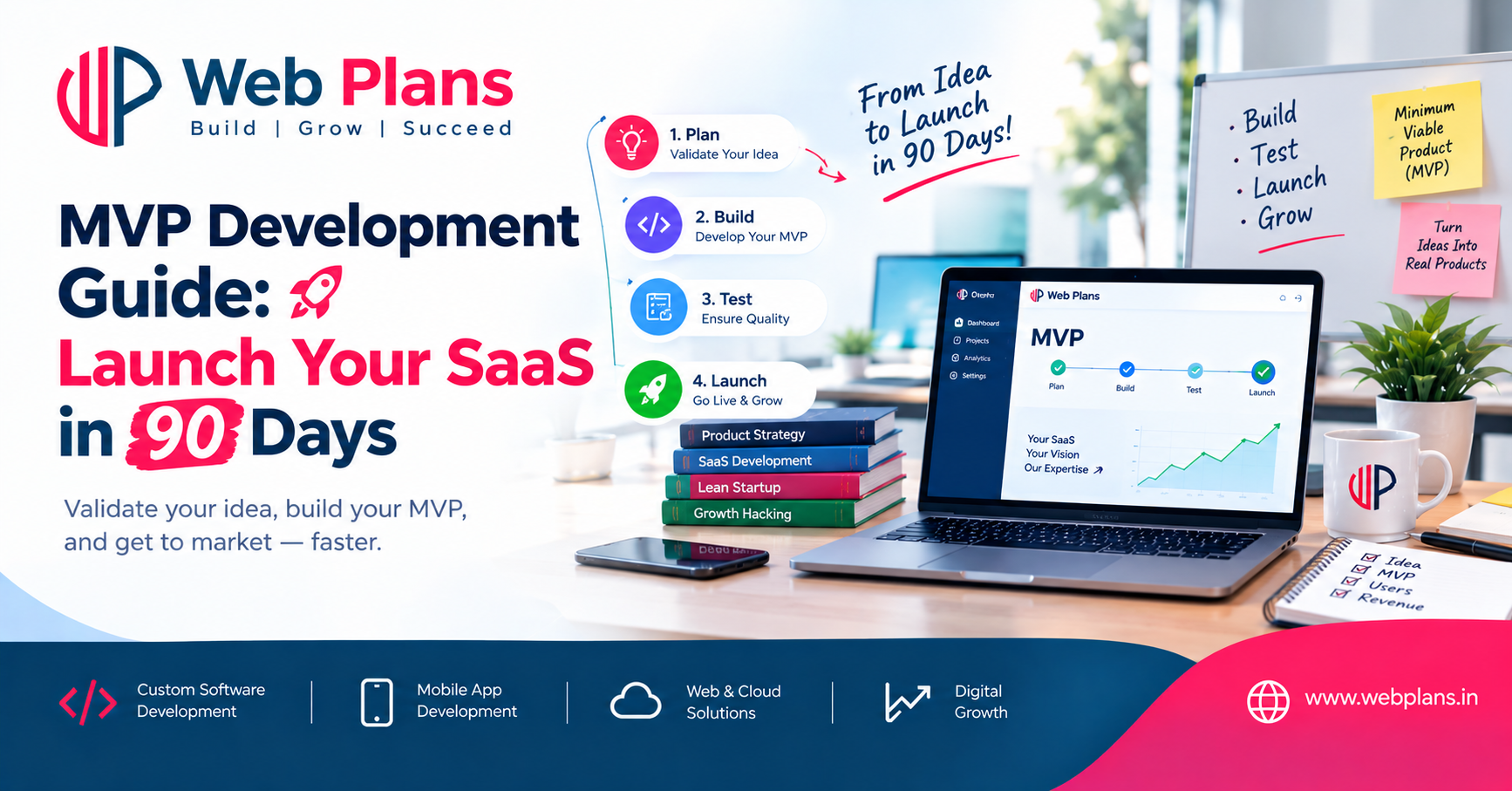
# MVP Development Guide: How to Launch Your SaaS Product in 90 Days
Bringing a software-as-a-service (SaaS) product to market is an exhilarating journey, but it is fraught with risk. Traditional software development often takes a year or more, draining your capital before you even validate whether anyone actually wants your product. Enter the Minimum Viable Product (MVP)—the ultimate strategy for modern founders.
If you want to beat your competitors to market and test your hypotheses with real users, you need a streamlined roadmap. This **MVP development guide** is designed to take you from a raw concept to a live SaaS launch in just 90 days.
---
## What is SaaS MVP Development and Why Do You Need It?
Before diving into the timeline, let’s define the core concept. A Minimum Viable Product is the simplest version of your software that delivers core value to early adopters while requiring the least amount of effort and development time to build.
Many first-time founders fall into the trap of "feature creep," trying to build a fully-fledged enterprise platform on day one. This wastes time and money. SaaS MVP development focuses strictly on solving *one* painful problem for *one* specific target audience.
### Key Benefits of Building an MVP:
* **Risk Reduction:** Test market demand before investing heavily in full-scale software engineering.
* **Faster Time-to-Market:** Get your product in front of users in weeks, not years.
* **User-Centric Feedback:** Shape your product roadmap based on real user behavior rather than guesswork.
* **Investor Readiness:** Show traction and a working product to secure seed funding.
---
## The 90-Day MVP Development Roadmap
Executing a software launch in three months requires absolute discipline. You cannot afford to waste time on indecision or scope expansion. Here is your week-by-week breakdown to success.
| Phase | Timeline | Primary Objective |
| :--- | :--- | :--- |
| **Phase 1: Discovery & Scoping** | Days 1 – 15 | Define core problem, user personas, and core feature set. |
| **Phase 2: Design & Prototyping** | Days 16 – 30 | Create UI/UX wireframes and interactive prototypes. |
| **Phase 3: Core Coding & Build** | Days 31 – 75 | Develop the backend, frontend, and basic database architecture. |
| **Phase 4: Testing & Launch** | Days 76 – 90 | Perform QA testing, fix bugs, and execute go-to-market. |
---
## Phase 1: Discovery, Validation, and Scoping (Days 1 – 15)
The foundation of successful SaaS product development happens long before a single line of code is written. During these first two weeks, your goal is to validate market demand and ruthlessly cut unnecessary features.
### 1. Identify the Core Value Proposition
What is the single most important transformation your software provides? If your SaaS helps remote teams schedule meetings, your core value proposition shouldn't include expense tracking or project management tools—yet. Focus solely on frictionless scheduling.
### 2. Define Your User Persona
Who feels this pain the most? Create a detailed profile of your ideal customer. Knowing their industry, daily frustrations, and software habits will guide every product decision you make.
### 3. Apply the MoSCoW Method for Feature Prioritization
Sort your feature ideas into four categories:
* **Must-haves:** Absolute non-negotiables for the product to function.
* **Should-haves:** Important, but not vital for day one.
* **Could-haves:** Nice-to-haves if time permits.
* **Won't-haves:** Explicitly out of scope for this MVP.
---
## Phase 2: UI/UX Design and Prototyping (Days 16 – 30)
Design is not just how a product looks; it is how it works. A clean, intuitive user interface (UI) ensures your early adopters can easily navigate your software and experience its core value without frustration.
### Designing for a Fast MVP:
* **Use Component Libraries:** Do not reinvent the wheel. Utilize UI kits and design systems like Tailwind CSS, Material-UI, or Shadcn UI to speed up the process.
* **Build Clickable Prototypes:** Use tools like Figma to create a clickable prototype. This allows you to test the user flow with potential users before writing code.
* **Keep It Simple:** Prioritize functionality and readability over complex animations or trendy graphic designs.
---
## Phase 3: Agile Coding and Development (Days 31 – 75)
This is the heavy-lifting phase where your software prototype transforms into a working application. To move quickly, lean on modern tech stacks and low-code or boilerplate solutions.
### Choosing Your Tech Stack
Speed is your primary metric here. Choose proven technologies that your development team knows well:
* **Frontend:** React, Next.js, or Vue.js for rapid user interface development.
* **Backend:** Node.js, Python (Django/FastAPI), or Ruby on Rails.
* **Database & Auth:** Supabase, Firebase, or PostgreSQL paired with Auth0 for quick user management and security setup.
### Lean Startup Development Tips:
* **Embrace No-Code/Low-Code Where Possible:** Utilize tools like Bubble, Make, or Zapier for internal workflows or supplementary features to save weeks of custom coding.
* **Build in Sprints:** Break your 45-day development window into two-week sprints. Review progress constantly and eliminate any features causing bottlenecks.
---
## Phase 4: Testing, Quality Assurance, and Launch (Days 76 – 90)
You are in the home stretch. The final 15 days are dedicated to ensuring your application is stable, secure, and ready for public consumption.
### Essential Pre-Launch Checklist:
1. **QA Testing:** Hunt down bugs, broken links, and responsive design issues across mobile and desktop devices.
2. **Security Checks:** Ensure data encryption, secure user authentication, and GDPR compliance if operating in Europe.
3. **Analytics Integration:** Install tools like PostHog, Mixpanel, or Google Analytics to track user retention and drop-off points.
4. **Billing Integration:** Set up Stripe or Lemon Squeezy to start collecting revenue from day one.
### Executing the Launch
Don't wait for perfection to launch. Get your SaaS product live on platforms like Product Hunt, Hacker News, and relevant niche communities. Collect feedback aggressively and prepare to ship iterative updates every week.
---
## Frequently Asked Questions
### What is the main goal of MVP development?
The primary goal is to test a business hypothesis with minimal financial investment and time, gathering actionable feedback from real users to guide future product iterations.
### How much does it cost to build a SaaS MVP?
Costs vary based on whether you build in-house, hire freelancers, or partner with an agency. A well-scoped MVP typically ranges from $10,000 to $40,000, depending on complexity.
### What happens after the MVP is launched?
Once launched, you must analyze user metrics, listen to customer feedback, fix bugs continuously, and gradually build out the "Should-haves" and "Could-haves" from your product roadmap.
### Can I build an MVP without coding experience?
Yes! Many founders successfully launch using no-code platforms like Bubble, Webflow, and Make, or by working with specialized development agencies.
### How do I know if my MVP is successful?
Success isn't necessarily instant profitability. An MVP is successful if it validates market demand, attracts a cohort of active daily users, and provides clear direction for product-market fit.
---
## Accelerate Your SaaS Journey with Web Plans
Building and launching a high-performing SaaS product in 90 days requires technical expertise, strategic scoping, and flawless execution. You don't have to navigate this complex journey alone.
Ready to turn your software idea into a market-ready reality? Partner with **Web Plans** for expert SaaS MVP development, rapid prototyping, and scalable software engineering. [Contact Web Plans today](#) to book your strategy consultation and accelerate your path to market!
Ready to build your project?
Get a free 30-minute consultation with our engineering team. No sales pitch — just technical clarity.